Sunday, July 3, 2011

The Process has begun

By “The Process,” I of course mean the absolutely insane amount of organizing, throwing away, giving away, mailing, and packing that stands between me and my night bus to Kunming on July 16th. This time frame is slightly complicated (mostly in a good way) by the fact that we were informed this week of a 9-day-vacation, beginning yesterday and extending to next Saturday night. This is bad for two reasons: 1) it cuts way down on review time, and 2) they told us late enough in the game that flying anywhere isn’t really a possibility. However, it is also great for two reasons: 1) there are plenty of places to visit that don’t involve flying, thus allowing me to take a “bonus” trip here in Yunnan, and 2) being away from school for a few days will leave me far less likely to be staring at the calendar on my computer, compulsively counting down the remaining days of class, days in Heqing, and days in China (7, 14, and 19, for the record). I’ve decided to go down south with Arianne, her mother (who’s visiting from the states), and Mark. We’ll be hanging out in tea country for a few days. I’m very excited. Apparently there are nicely sized blocks of really good tea available for very cheap. I’ll leave today and get back probably on Friday, after an overnight in Dali on the way up.


We found out a week or two ago that Pengtun isn’t going to be a TFC school next year. Since Yiming and I are both leaving, Malijun is moving to an elementary school, and the school isn’t really dealing with a teacher shortage, the admins of both the school and TFC decided it’d be better to move Mark to another school rather than move 2-3 new fellows in. Well, that’s the official reason. There are others, I’m sure, like our test scores. TFC fellows in schools down south have had their bans (classes) taken away from them because of poor grades, and they spent this semester teaching oral English to most students in the school. There’s nothing wrong with that—in fact, I think in many cases oral English instruction would be a much more appropriate use for TFC teachers than being in charge of a ban’s complete English instruction—but it does show the natural frustration some schools are feeling with our less-than-stellar results.


But enough of that. What all of us meaning Pengtun means is that I will not be able to treat my room as a college house, as it were. My last two years at Mac, I lived in homes that had been inherited from and were subsequently passed on to Mac students. It was a pretty great deal, because we got each place mostly furnished and were able to take and leave whatever we wished when we moved out. This year, however, will be more like my first two years in college, when I lived in the dorms and a move out meant that everything other than school-provided furniture must go. We’re still not entirely clear on what belongs to the school and what doesn’t, since when we got here we already had quite a bit remaining from last year’s fellows, so that complicates things.


Packing will be a slow process, not least because I know that the more I take my room apart the more I’ll be fixated upon getting out of it. Yesterday I mailed a box of books and cards (padded with winter socks) that I’ve received over the course of the year. It was less expensive than I thought it might be, which was a relief, but as I sent it by freight who knows when I’ll get it? I also threw away a bunch of papers and other miscellaneous stuff, including my 10-month-old box of really expensive and really disgusting pork mooncakes (a gift from the school) that I smuggled out to the dumpster in the dead of night. I organized my desk drawers and collected a bag of clothes to give away. Clothes to throw away will be dealt with later. I’m paring down my pantry, trying to use up stuff and pass along/toss things I don’t think I’ll ever end up eating. There are a whole lot of decisions to be made concerning such questions as how much of my pharmacy to try to take home with me, whether or not to hang onto clothes that I like but that aren’t in fantastic shape, etc. Most of these decisions will need to be made post trip, but I’m glad to at least have gotten things going.


Anyway, not to harp entirely upon the leaving on Heqing, I share here a few stories of recent life.


Why did the chicken cross the road?

I contemplated the timeless question as I braked on my bike, then swerved to the right so as not to hit the two roosters casually bobbing their way across my path. When I bike to town, I go over a mix of cement, dirt/mud (depending on the amount of rain), cobblestones, asphalt. The way I usually go, I pass through most of Pengtun, dip out onto the DaLiLu for a minute, and then cut back in to villages closer to town. I am as likely to run across a cow as I am a car, likely to see more tragons than tour busses, and not at all surprised when I find myself needing to slow in order to keep fowl alive. The other day, I also became an impromptu horse whisperer, when a foal somehow traipsed its way out of the field and onto the Pengtun village road, a few meters from the DaLiLu. While its mother neighed in what I’m sure was a most potent combination of exasperation and fear, I got off my bike and tried to coax the little horse back down. It didn’t quite work, but he at least moved farther away from the big road.


Commie Party

As some of you fine folks might know, the CCP celebrated 90 years on July 1st, and, as such, there was a bit of hoopla around here. All of the teachers at Pengtun, and all of the teachers from other schools in the area, were required to participate in a local singing exposition/talent show. Mark and I got out of this, somehow, which is probably a good thing as it’s possible I’ll run for office some day, and Mark’s Chinese side of the family fled to Hong Kong in part because of that whole communism thing. The other teachers were required to rehearse before evening classes a few times a week, and, I must say, they were good. It’s not entirely unheard of for teachers in American schools to be drafted into singing during talent shows or other events, but I feel like the spirit there is always one of light, slightly embarrassed indulgence. There is no harmony, no solemnity.

As Mark and I watched the teachers perform, I found myself subject to the rather furious pokings of an old woman who, for some reason or another, reaaaallly didn’t like me. I could not understand a word she was saying, but she poked me for a few minutes.


On Friday night, the actual 90 Year Celebration day, I got a text from one of my very sweet and not very intelligent girls that read something like this (forgive my translation skills):


“Burning hot weather, burning hot happiness, I wish you with the Party constant good fortune, I wish you with the Party constant good luck, I wish you with the Party constant happiness, I wish you with the Party constant luck in love. On July 1st, be happy happy!”

Friday, June 24, 2011

China Birthday

I’m 24 years old. I’m in my mid-twenties—no longer a fresh-out-of-college 22-year-old but a 2-year veteran of the “real world” (whatever that means).


As with so many other stages in life, I’ve reached this point only to realize that “wait, I still don’t know what I’m doing.”


I have a clear memory of little 2nd-grade me walking up the stairs of Mary Munford Elementary School, gazing at the gargantuan fifth graders up ahead, and knowing, without a lick of doubt, that these kids understood what was going on. They had everything all figured out.


Only, then, one day, I was a fifth grader, and there was still a lot I didn’t get. But middle schoolers, they were sure to understand it all. …Nope.


Well, perhaps once I was in high school and knew how to drive, or perhaps once I got to college, or got to be a senior in college, or graduated from college, or went to live on the other side of the world…. Oh. So all the wisdom and knowledge of adulthood doesn’t just show up one day?


Shucks.


Anyway, I’ve celebrated my last several birthdays away from my family, but this was my first time celebrating abroad, and, because I have a summer birthday, it was also my first time celebrating on a regular old workday. Hence, much of my day didn’t feel all that birthday-like. I’d told my students that I wanted my present to be good behavior, but for my first two classes that was apparently too much to ask. I got to skype with a friend for about ten minutes during the afternoon, and Malijun gave me a beer, but but frankly, I was pretty mopey until after my 3 o’clock class.


I still had a couple of hours before my evening marathon class, so I decided to bike into town for bubble tea and also pick up a bar of chocolate to supplement the ghiradellhi Mark was kind enough to bring me back from America. I made a rice cooker cake. Specifically I made a mint mocha cake (chocolate with hints of mint and coffee) with a thin coffee frosting/filling between the two layers and a bailey’s (again, courtesy of Mark) chocolate glaze over top. It was, unfortunately, rather ugly when done, so no pictures. But it was darn tasty.


The first half hour of the evening class was its usual self—reviewing vocabulary and the like. Then, after the five-minute break, we went outside and spent the next half an hour playing basketball against Yiming’s class.

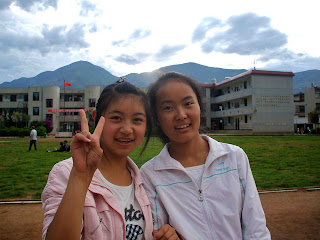
Class 82 has major troublemakers who happen to be talented basketball players. Despite a rule stating that only two of my class’s top five players could be on the court at any moment, we crushed the opposition. Meanwhile, I took pictures of my kids (whether they wanted to be photographed or not). Here we have Mike and Zach, and Laura and Sam (Samantha, she now insists, after the mortifying discovery of Sam listed in the textbook as a "boy's name").


Yiming’s class went in at 7:30, and we stayed out until 8. (I’d decided over the weekend that I might have an evening class on my birthday, but I was not going to spend the whole two hours fighting my students into being quiet and listening while we covered real content.)

Some of my kids opted to keep playing basketball, and a few asked if they could go back to the classroom and do homework, but I managed to corral the rest into learning all about the very important American staples of duck duck goose, octopus tag, and red rover. It was silly and fun. After I shepherded them back inside, I saw that the trustworthy girls I’d allowed to go in early and start their homework had,


in fact, decorated the entire blackboard with birthday wishes. The
class sang me happy birthday in English and Chinese. I got presents from two students and notes from a few more (see pictures of presents. They are epic things, they are). Touched, I thanked them profusely. Then it was homework time. Most kids were tired enough from all the running around that they either buckled down into work or at least kept quiet so their classmates could. All in all, it was a lovely class.

After the bell rang, I headed back to my room. Mark had candles leftover from Malijun’s birthday a few weeks ago, so I stuck them in my cake and got the gang over. Yiming’s girlfriend, who was visiting from Hong Kong, made a small fruit salad, and Yiming gave me a plant that’s currently sucking up sunshine on my windowsill. We ate the cake (sadly for me, no leftovers remaining), and just relaxed for a little while before splitting up so we could all get work done for Tuesday morning. It was not a typical American birthday, perhaps, but that doesn't mean it wasn't memorable.

Thursday, June 16, 2011

Slipping Towards Sunset

My family and some friends have known for awhile, but just to clear up any confusion, I’ll go ahead and say straight up that I’m planning on returning home this summer rather than remaining in China for a second year. There are a number of reasons for this—some organizational, others purely personal—and I don’t feel like a public blog is the best forum to discuss them. So, suffice it to say, this was a decision that took me a long, long time to make, and although it’s got its downsides, overall, it’s right for me.

Nonetheless, I feel so incredibly fortunate to have been able to be a part of this place that will, every day, affect the way I think about life once I’m home. For all its challenges, this is perhaps the most personally worthwhile experience I’ve had, and I remain so humbled by the degree to which the people who call Heqing home have let me make it mine, for this short time.

I’ve got exactly five weeks left as of today (Thursday, here in Yunnan) before hopping on a plane to Chicago and then on to Atlanta. I’ll be going to Beijing a few days before that, and I’m lucky enough to be able to zip off to Tianjin for a day to attend a family friend’s wedding!

Anyway, during these last bits of time I have here, I’m trying to absorb as much as possible, to live as much as possible. This is made slightly harder by the rain, about which I have composed a not-entirely-original poem:

Rain, rain, go away
Though the fields want you to stay
You make it grey all day
So I want to go home today

I’m affected strongly by weather. Always have been, really. It’s amazing how sleepy the rain makes me. Lesson planning through the last month was already gonna be something of a challenge, just by nature of it being the last month, but now it’s gonna be laced with the extra difficulty of overcoming grey. Ah well.

On the plus side, living in a generally rainy environment these days makes the non-rainy moments all the more wonderful. Tuesday, I biked into town for what has become a mostly weekly ritual of meeting up with Hallie and Arianne and Mark for bubble tea. Only, that evening, we were also having dinner with Yiming and Malijun and Yiming’s girlfriend, who’s visiting from Hong Kong. Because of this, we ended up being in Heqing until close to 8, at which point the sky was beginning to turn towards dusk.

I rode back alone (Mark had to stop by the store, and the Chinese fellows don’t have bikes), starting out on my usual route and then branching off to take a dirt road I’d not tried before.

It was a beautiful evening. Quiet, with a touch of a breeze, cool without being cold, as is so often the case in the basin here. Pedaling along, I caught the glances of the last of the farmers coming in from their fields. The older men, brows furrowing atop eyelids, often give me slightly hardened looks, trying to place this strange figure in her coral rain jacket. I don’t think there’s ever any sort of resentment, just interest in the disruption from normalcy. Women, young and old both, are often more forthcoming, smiles tentative but frequent. The younger men, students or those who should be but didn’t test in, are typically the only potentially aggravating sort. I get “hello” from a lot of people, but it’s the teenage and 20-something boys that really like to shout it, over and over, usually beginning just as I’ve passed by and continuing until I’m out of earshot. On good days, I grin at the silliness of it. On bad days, I roll my eyes and occasionally mutter things in English that it’s probably fortunate they can’t understand.


Tuesday evening, clouds caressed but didn’t smother the sky. Streaks of pink blended into pale blues and whites outlining the western mountains. The tower, the one we hiked to three months past, stood in steady black, crowning the highest peak, a vessel for the waning sun’s rays peaking through to drape over the stone, the earth, down into the rice paddies below. And to the north, layered cloud upon cloud upon cloud, grey to silver to gold.

I biked through the dirt paths dividing field from field, listening to the soft songs of waterfowl, witness to the simple but captivating beauty of this place. Heqing has modernized a great deal but still runs, in some respects, like I expect it has for centuries. Farming is done mostly by hand. It’s quiet, no machinery disrupting the rhythm of planting and harvest and everything in between. I’ve grown used to the sight of rice paddies dotted by men and women, the latter’s hats wrapped with bright scarves. Sound comes only from the motorized wagons and from the main road, something that didn’t exist not so long ago.

Rural China is full of frustrations, especially for those of us accustomed to a first world standard of living. But moments on my bike, feeling free as anything; moments wandering through Heqing town and through the market in particular; moments with my students when they’re being the silly but loveable young teens that they (sometimes) are; those are the times when my smile bursts forth. Those are the times I want to remember.

Saturday, June 11, 2011

Mumblings of a Country Bumpkin

It’s getting harder for me to keep my languages straight.

In the past couple weeks especially I’ve found myself using more Chinese words when talking to family and friends back home and I’ve found myself in more situations with local teachers, and my students, where I’m about to start speaking English. Part of this, at least on the English-instead-of-Chinese end, is connected to the fact that I’ve been trying to use more English in the classroom, beyond what my kids are capable of understanding, just to get the sound in their ears. But let me tell you, it feels pretty darn silly to be standing in front of 40-something tweens, in the middle of a grammar explanation or the like, only to find oneself needing to stop and recalibrate.

You know what else feels silly? Trying to eat spaghetti with a fork and spoon. It’s so much harder than I remembered! This is my reward, it would seem, for eating everything except oatmeal and soup with chopsticks. The thing about chopsticks is that they’re very good for multitasking. The fork-and-spoon spaghetti was a delicious pasta primavera I ordered for lunch at a café in Lijiang. I’d gone up for the day to get some major lesson planning done, and I succeeded—a whole week’s worth of lessons in 3 hours. The cappuccino probably helped. But, anyway, I was working as I ate, which is not uncommon for me. What made it difficult is that spaghetti with a fork is more or less a two-handed operation. You have to twirl it on the spoon, and then what do you do if you get too much? It’s so much easier with chopsticks, where you just pick up what you like, slurp it in, and, if necessary, use your teeth to cut it off. I might eat like a country bumpkin, which I suppose I am here, but at least it’s less embarrassing than trying to shove a huge mouthful of spaghetti into my mouth while praying that the fancy Chinese tourist sitting two tables over keeps looking at his cellphone and not at me.

Speaking of noodles, sad news. My favorite kind of rice noodles here, ersi, have never had an amazing shelf life, but until recently they’d last 2 or 3 days after purchasing and before molding. No more. I bought ersi Saturday morning, made dinner with them that evening, and then intended to use the remainder for dinner on Sunday…only to find a speckling of green and white spots. Alas. Summer is in many ways a wonderful thing, but it means that food purchases must be smaller and more frequent, although I can always go to the cafeteria and buy vegetables if I find myself unable to get into town.

Getting into town is seeming less and less an “event,” however. Earlier in the year, I went in about once a week, sometimes twice (on Friday and Sunday) and usually spent quite awhile wandering about. Getting into the city typically took 15 minutes of waiting for a bus and standing crammed up against all the other riders, and walking from the bus stop to the grocery store to the outdoor market and back to the bus stop required at least an hour or so. However, with my bike, getting into town takes 15-20 minutes of pleasant peddling along back village roads, and zipping about Heqing takes hardly any time at all. It’s nice to feel as though I can go in on almost any weekday I like, even weekdays when I have evening class. So as long as it’s not pouring down rain I imagine I’ll continue to get into town much more frequently during the rest of the year.

Unfortunately, the rain seems to have arrived. I want to go into town this morning, and I suppose at some point I shall bite the bullet and just go, but the deluge is making me less than inspired.

In other news, my kids can beat me at basketball. That’s not entirely unexpected, but it’s humbling nonetheless, particularly when, in the course of beating me, they manage to accidently knock me to the ground, legs flying in the air. Granted, I pretty much ran right into my sturdiest and strongest boy, so I guess I asked for it. I grinned and let two concerned girls pull me back to my feet. My head hurt, but my pride ached more.

Sunday, May 29, 2011

On Sustainability (and the Goodness of Mangoes)

Last week I was skyping with a friend and we had an exchange that went something like this:


Friend: My house is getting chickens! And I’m trying to figure out what to do with this week’s veggies from the CSA (that’s Community Supported Agriculture , not Confederate States of America).


Me: That’s so awesome. Man, I miss being sustainable.


Me:…. Except that I’m probably more sustainable here than I ever have been in my life. So I guess I miss being American-Hippie-Sustainable. Hmm.


The thing is, whether it’s a fad or a legitimate shift in people’s lifestyles and politics, American-style ‘sustainability’ can be quite fun. It’s fun to go to food co-ops farmers’ markets and to justify spending more than at a typical grocery store because you’re supporting local/ethical/organic/(inset other green adjective) produce/dairy/meat. It’s fun to make more and more food from scratch so as to avoid supporting big, scary corporations. It’s fun to walk and bike around during the non-snowy months in Minneapolis, availing oneself of the pedestrian highway to get to work/the store/the lakes/wherever. It’s fun to have power challenges where one finds non-electricity draining activities to consume one’s time for a day a week or the like.


Generally speaking, the practices that I think of as “sustainable” in the American context are also very pleasant ones, particularly during the warmer months, and indeed, during the winter months I would have killed for a car (my housemates from last year can both attest to this), and I kept the heat down only to save money. Basically, I liked sustainability when it was convenient.


This year, I am very, very sustainable, and not really by choice. I don’t use a flushing toilet more than a few times a month, on the occasions when we’re in Dali or Lijiang or one of Heqing’s “fancy” restaurants with other CEI folks (we’re TFC now, by the way—Teach for China). I shower three times a week at most, and with solar-heated water at that, and beyond that wash my hair once or twice a week in a basin with a kettleful of water I’ve boiled on my hotplate. I hand wash all my laundry, and it air-dries. And I obviously don’t have a dishwasher. Having running water in our rooms now means that I use more than I used to, but I’m still pretty conservative I’d say. I certainly drink less water than I did in the States, since I have to boil it first and more liquid means needing to use the bathroom more, which is something I’m less than excited to do. Frankly, life here is dirtier. I’m dirtier, my clothes are dirtier, my room is dirtier (dirt manages to make its way in regularly, no matter how much I sweep, since there’s no way to completely seal the door from the outside). You get used to it.


I don’t think I’m using all that much electricity—lights at night, and the hotplate several times a day for boiling water and for cooking. I also use the rice cooker at least once a day. My computer’s plugged in most of the time, and I charge my phone once or twice a week, but that’s about it in terms of appliances.


Generally, when I’m in a motorized vehicle it’s a public one, and even those I’m using less and less. Now that I have a working bike I mostly ride that into and around town, so I only end up bussing to Lijiang and Dali every several weeks. And once I’m in town I buy all my produce, eggs, noodles, and tofu from the market, so that’s all very local. I joke about the people at the supermarkets thinking that the only things I eat are oil, soy sauce, rice vinegar, sesame oil, sesame seeds, nuts, oatmeal, sugar, chocolate, flour, powdered milk, and instant coffee and bubble tea, because I never buy my “fresh” food there. And since I’m trying to cut back on sugar, flour, and chocolate my purchases at the supermarkets are getting smaller and smaller in nature. Even at the supermarket, many products are from Yunnan or neighboring provinces; it’s just the nature of China.


As I don’t have a refrigerator, I’m less likely to have food go to waste, because I buy it in small enough increments that it’s difficult to forget about it. (There are no crispers or “behind the big Tupperware of leftovers” spots for rogue veggies to hide.) I’ve also, shall we say, entirely dismissed any notions of food safety being based on temperature. Is this a mistake? Perhaps. But I remember being nervous, last summer, about having eggs and veggies out on the counter for a couple of hours. Now I leave eggs out for as long as it takes me to eat them (I buy six at a time, usually, about once a week), and the order in which I use my veggies/other fresh food is based mostly on speed of decay (tofu, greens, and fresh noodles, I’ve learned, should be used within two days tops). Generally, unless something smells or feels off, I consider it good to go.


And, aside from food, I really don’t buy much. I get toilet paper/napkins/paper towels/tissues (it’s a one-size fits all kinda thing—what we would consider four distinct products, with perhaps some overlap, under duress, between tissues and toilet paper, is simply sold as “sanitary paper” here and used for all four purposes). I buy yarn occasionally, and toothpaste and shampoo and the like even more occasionally, and I’ll get steamed buns and rice noodle spring rolls and bubble tea when I’m wandering about town, but on the whole it’s rare for me to spend more than 100 kuai in a week unless I’m mailing a package, adding money to my phone, or heading to the Western Food land of Lijiang or Dali.


Of course, this year I’m also taking two trans-Pacific flights, so how those jaunts alone impact my carbon footprint…well, it can’t really be helped. And, aside from the monster flights, I’ve flown (for me) seldom. Beijing to Kunming way back in July, and then Kunming to Bangkok, Bangkok to Hong Kong, and Kunming to Lijiang over the long break. None of those flights was more than three hours, and Kunming to Lijiang was just a baby hop of 45 minutes. I spent my last five years in the States living in Minnesota with my family in Georgia, extended family in California, and friends all over, so it was rare for me to go more than three or four months without flying somewhere.


As for how I’ll maintain my sustainable lifestyle, or not, once I get home, well, we’ll see. I fantasize about my bathroom in Georgia—the one next to my bedroom with a flushing toilet and a shower that always provides hot water. I’m sure I’ll buy more clothes and the like, because I’ll enjoy the fact that not everything in America is covered in glitter, and I’ll probably wash those clothes in a washing machine, and more often. But I’ll continue to buy as locally as I can, and as ethically as I can. I’ll be aware of the gift of a hot shower and a flushing toilet more than I ever have been. I’ll treasure ice and water that needn’t be boiled before drinking. And perhaps I’ll try to come up with ways to be American-style sustainable that are not only pleasant but also a daily reminder of the manner in which most people live in this world of ours.


On a different note, living in a farming community has given me a deeper appreciation for seasons of different crops. There are some veggies, like broccoli, that I continue to purchase regardless of the season, but a lot of the fruit especially that makes its way to my kitchen is based on what’s looking best these days. I’m learning more about the lengths of different crops’ seasons. Cherries, for example, were absolutely everywhere for about three weeks, and then they disappeared entirely. Plums have been around for a month or so and don’t look like they’re going anywhere (in fact, they’re getting bigger), and mangoes are now 4 kuai a jing, meaning that I got 3 large, ripe ones for about $1 USD. I pray that mango season is a long one.


I’m not sure there is anything quite so wonderful, in terms of fruit consumption, as gorging oneself on a perfectly ripe mango. I love fruit, and I’m not sure mangoes are my favorite flavor-wise, but they’re just so much fun to eat! Cutting around the seed, “popping” the cubes open, cutting around the seed some more, taking the seed with both hands and slurping mango pulp such that it gets absolutely everywhere and when all the orangey goodness is gone you’re left covered in juice, feeling six years old, fumbling for the faucet…good times.

Friday, May 27, 2011

Silkworms, Steak knives, Crawfish, and other Adventures of May

My room has gotten a little more crowded lately.


First of all there’s Saffton. Saffron is my silk worm. You see, last week Peter was playing with something in his desk. That isn’t at all unusual, but normally he’s messing with a pocketknife and a stick or trying to surreptitiously swigging of pepsi. On that day, however, he happened to have in his possession something else entirely—a rather large, white worm. He held it up as if hoping to scare me and then set it on his desk, wherefrom I plucked it, and, ignoring the screams of my female students, walked it over to the windowsill. I stuck it there, but it didn’t seem too happy, so at the end of class I took pity and brought her back to my room. I found out that she was a silkworm from Yiming. Malijun shrieked, pronounced it scary and ugly, and ran away. Silkworms only eat mulberry leaves. Luckily, there are several mulberry bushes quite near the school, so I ventured out once every couple days to get her a new stash. Over the weekend she built a cocoon, so in a week or two I should have my very own moth. Unfortunately, the moths only live for a few days and can’t eat or fly. Still, pets are good.


I wish Saffron was my only pet, but this is apparently fly season, which means that there are not 1 or 2 but rather at least a dozen flies buzzing about my room. This is the punishment, I suppose, for having a room that cannot ever be completely closed off from the outside. They like my computer. There are three on it as I type—no, make that four—and I’ve grown accustomed to the little colony that forms on the edge of my keyboard. Fun times.


Speaking of fun times, I’ve collected, over the course of this year, quite a few knives from my students. Most are of the pocketknife variety and are not particularly scary. Two nights ago, however, I pulled from William’s desk, despite his best efforts to divert me from it, a full-fledged steak knife. He was only cutting up the desk and not his classmates, which I suppose is a plus, but it nonetheless caught me somewhat off-guard.


As if that wasn’t enough, yesterday I walked into class to find a very big, very much alive crawfish on my desk. The boys who’d put it there tried to snatch it back, but I held onto it and brought it to the lake after class ended.


When we first arrived in Heqing last August, we had nary a day of sunshine in a good month. I remember seeing patches of blue in early October and being amazed by them. We’re heading back into the rainy season now, so there’re a lot of days that range from brightest sun to rainclouds and back. I’m taking as much advantage of the non-rainy weather as possible, biking into town a few times a week and going on walks and the like. I’ve discovered a way to town that goes along village roads instead of the main ones. There’s prettier scenery and less traffic. There’s also a whole lotta straw and other plants on the road. This is apparently the time of year when the farmers beat the seeds from last season’s crops, and to take some of the work out of the process they often lay the plants out so cars and motorcycles and people will dislodge the seeds.


Last Saturday, Mark and I went to visit three of my students in their village, about a half hour bike ride away. We didn’t know exactly how to get there and ended up biking through a lot of fields and, on more than one occasion, having to half drag, half carry our bikes between fields over these rather precarious ladder/bridge contraptions.


The thing about Chinese villages is that there are not street names or, often enough, distinctive homes and landmarks. It’s mostly a lot of fields and dirt or cement roads. Thus, when we finally reached the village, I called Malia to ask where to meet her, only to discover that clear directions weren’t in the forecast. Luckily, we stumbled upon an eighth grader from our school who guided us, on her own bike, to Malia and Molly.


The visit was fun. I got to see three of my students’ homes and get a tour of their village. They were really excited to see me outside of school too.


We’re kinda-sorta-a little bit coming into the home stretch. I have three units of new material left, followed by review time. This semester is much less demanding, time wise, than the last, when Mark and I were absolutely scrambling to fit everything in by the end. School goes until sometime in July, but whether it’s the 10th or the 20th or even later is still very much uncertain. This made buying a ticket home difficult, but I did. July 25th. Beijing to Atlanta. I am ever so excited. In the meantime, I’m trying to get as much out of these final two months as possible. I may be ready to go home, but I also know that this is in some significant respects the most extraordinary circumstance I’m likely to find myself in for years.


For now, it’s Friday afternoon, which means a major room cleanup, reading time, and perhaps a trip into town for bubble tea and groceries. Weekends are good. I'm going to try to get a new batch of pictures up soon, so stay posted.

Thursday, May 12, 2011

Pengtun Cooking- Rice Noodle, Broccoli, and Tofu Stir-fry

So, it’s been a good long while, I realize, since I posted a recipe for a chocolate zucchini rice cooker cake and an intention to write up more recipes. However, better late than never.


This is not a rice cooker recipe. It’s not actually served with rice but rather with what is probably among my very favorite foods in China, 二丝 (ersi). The Dali area is famous for its ersi, thick and glutinous rice noodles that are often served in broth with meat sauce for breakfast but are also lovely stir-fried.


I realized this week that, at this point, for me to use a recipe for fried rice or a stir-fry seems as silly a notion as using a recipe for a sandwich. Aside from baking adventures and occasional pancakes and curry and the like, everything I make comes out of the wok. I no longer think about the order of putting things in, the temperature needed, or amounts of rice wine/vinegar/soy sauce/sesame oil/etc. And I can’t imagine a kitchen without a wok ever existing in my future.


Really, quite a bit’s changed about my eating habits this year, and a lot of it’s not for the better. I eat more sugar, fewer whole grains, and, I’m sure, a ton of pesticides. But I love the market and eat a heck of a lot of fresh produce. In fact, I imagine that the people at the grocery store think that all I eat is sugar and rice and oatmeal, because veggies, fruit, tofu, eggs, and noodles are all easily found elsewhere. My eating manners have also changed. We Heqing fellows joke about how we’ve turned into country bumpkins, slurping from our bowls. And I eat pretty much everything except oatmeal and baked goods with chopsticks. Those two get spoons. Yes. Baked goods too. I was skyping with my family about a month ago, and they were extremely perplexed to see me scooping banana bread out of a bowl, with a spoon. Oops.


Anyway, pretty early on in the year, I discovered that ersi stir-fried with broccoli, tofu, ginger, and garlic is a truly awesome dish, and I’ve made it probably at least once a week since.


Because I’ve never run into anything like ersi in the states, I’m not sure exactly how this should be replicated in an American kitchen, but I think a pad-thai type sort of noodle would work. Everything else is easily findable in American stores, although one of the things I’ll miss most about China is buying my tofu and noodles fresh at the market, along with huge hunks of ginger, garlic, and broccoli direct from the Baizu farmers. Amounts are, obviously, approximate, and really don’t matter—just use however much of each as you like.

Noodle, Broccoli, and Tofu Stir-fry

Ingredients

-A cup or so of broccoli stem and florets, chopped roughly

-Half a cup of tofu, moisture squeezed out and diced

-a large handful of fresh rice noodles (or an equivalent amount of dried rice noodles, cooked)

-about 2 cloves garlic, diced

-a half inch piece of ginger, diced

-a tablespoon of roasted peanuts, chopped or whole

-rice vinegar to taste (maybe a teaspoon)

-soy sauce to taste (1-2 teaspoons)

-a drizzle of sesame oil

-sesame seeds to garnish

-oil for the wok

-water


Procedure

1) If you want your tofu crispy, fry it first and remove from the wok. I’m bad at frying things, so no tips here.

2) Heat the wok over medium-high and add perhaps a teaspoon of cooking oil (I use peanut here, but I assume anything would work), along with a pinch of salt. Swirl to coat.

3) When the oil’s spitting a little, put in the broccoli, garlic, and ginger and stir-fry briefly, tossing about so it doesn’t burn. If your wok starts to smoke, you might need to add a touch more oil.

4) After a minute or two, turn the heat up a little bit and add a couple tablespoons of water. Stir-fry, letting the broccoli absorb the water and turn a lovely shade of green. Try a piece and add another tablespoon of water if it’s still really crunchy. You want it a little crunchier than how you like to eat it. Turn the heat back down to medium.

<

5) If you haven’t fried the tofu, put it in now and stir-fry briefly before adding the rice noodles. Stir-fry for a minute or so and then, if using fresh noodles, add another tablespoon or so of water so they’ll soften. Stir in a circle to keep the noodles from sticking, and add your vinegar, soy sauce, peanuts, and sesame seeds.

6) Continue to stir until ingredients are incorporated and the noodles and tofu are cooked through.

7) Serve, topped with a drizzle of sesame oil and more sesame seeds, if desired. Sometimes, I also add chopped scallions, but it’s just as good without.